Blog Post

Sustainability Meets Efficiency

The Dual Advantage of Berstron’s Harvester

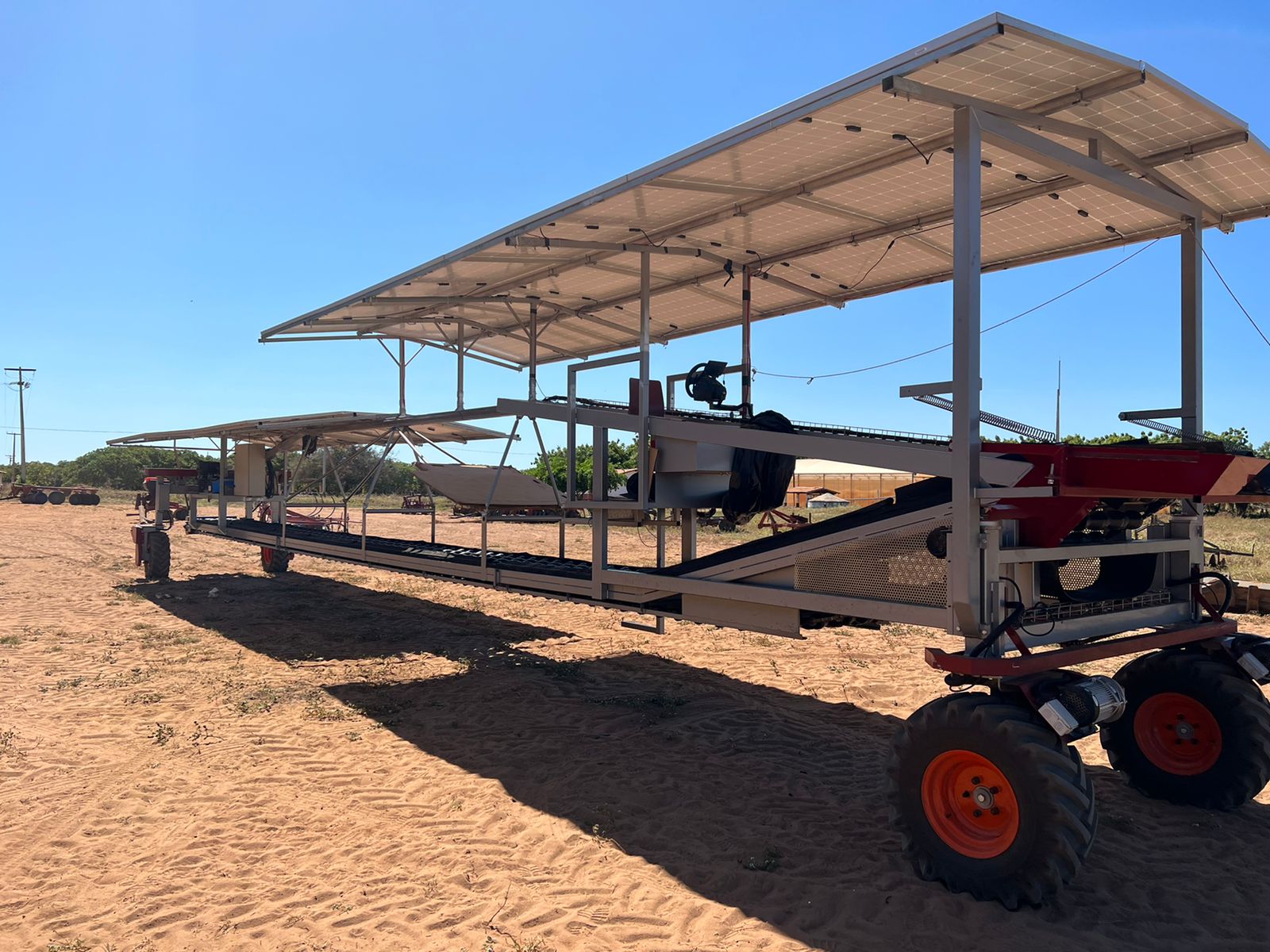
In today’s agricultural landscape, two words resonate deeply: sustainability and efficiency. While they may seem like separate entities, Berstron’s solar-powered harvester beautifully marries the two, offering melon farmers a solution that’s both eco-friendly and highly effective.

The quest for sustainability in farming is not a mere trend; it’s a necessity. As the world grapples with the effects of climate change, the agricultural sector faces the challenge of producing more with fewer resources, all while minimizing its environmental impact. Berstron’s harvester rises to this challenge with its solar-driven design, reducing greenhouse gas emissions and conserving non-renewable energy sources.

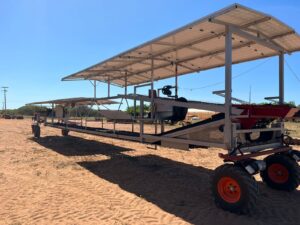
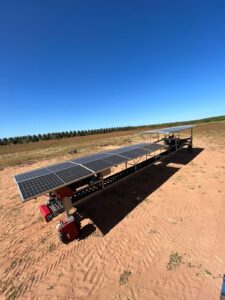
But sustainability doesn’t come at the cost of efficiency. On the contrary, the harvester’s solar panels, capable of generating up to 10.8 kW in optimal conditions, ensure that the machine operates at peak performance throughout the day. And with features like a 2-hour battery reserve and a backup petrol generator, operations remain uninterrupted, even in less-than-ideal conditions.

The harvester’s dimensions, spanning 18 meters in length and 3 meters in width, coupled with its ability to reach speeds of up to 10 km/h, further enhance its efficiency. Whether it’s navigating vast melon fields or maneuvering through tighter spaces, the machine’s design ensures optimal harvest yields.

In essence, Berstron’s solar-powered harvester is a testament to the fact that sustainability and efficiency can coexist harmoniously. It’s a beacon of hope for melon farmers seeking to adapt to the changing times while optimizing their yields.


#BerstronSolarPoweredHarvester, #SustainableMelonFarming, #EfficientAgriculturalMachinery, #SolarDrivenFarmingSolutions, #GreenhouseGasReductionInAgriculture, #HighPerformanceSolarPanelsInFarming, #EcoFriendlyHarvestingEquipment, #OptimalHarvestYieldsWithSolarPower, #FarmingAdaptationsForClimateChange, #BerstronHarvesterDimensionsAndSpeed, #UninterruptedFarmingOperations, #BackupSystemsInAgriculturalMachinery, #SustainableAndEfficientFarmingTools, #MelonFarmingInnovations, #BerstronsDualAdvantageInAgriculture.

Harnessing the Sun

How Berstron’s Harvester is Revolutionizing Melon Farms


The sun has been a constant companion to farmers since the dawn of agriculture. Its rays have nurtured crops, dictated seasons, and influenced farming decisions. Today, Berstron takes this age-old relationship a step further, transforming sunlight into a powerful tool for modern-day melon farming.

Berstron’s solar-powered harvester is not just a machine; it’s a symbol of evolution in agricultural practices. By capturing the sun’s energy through its advanced solar panels, this harvester operates with unparalleled efficiency, reducing the reliance on traditional fuel sources and slashing operational costs.

But the benefits don’t stop at savings. By transitioning to solar energy, melon farms can significantly reduce their carbon footprint. In a world grappling with climate change, this shift towards sustainable farming is not just commendable; it’s essential.

Moreover, the harvester’s design ensures optimal energy capture. With 24 panels, each boasting a capacity of 450W, the machine can generate up to 10.8 kW in ideal sunlight conditions. This robust energy generation ensures that the harvester can function seamlessly, even when the skies are overcast.

As melon farms across the globe seek innovative solutions to enhance productivity and sustainability, Berstron’s solar-powered harvester emerges as a frontrunner. It’s not just about embracing technology; it’s about harnessing nature’s most abundant resource to fuel our future.


Interested in integrating solar power into your farming operations? Discover more about Berstron’s cutting-edge solutions. Reach out to us at MarcvanOers@berstron.com or call/WhatsApp +34 66 649 1154. For further details, visit our dedicated page here.

Traditional vs. Modern: A Comparative Study of Palletizers

Traditional vs. Modern: A Comparative Study of Palletizers


In the world of material handling, palletizing technology has seen significant advancements. The two primary types of palletizers in use today are traditional simple layer palletizers and modern robotic palletizers. Each has its unique advantages, and the choice between the two often depends on the specific needs of a business.

Traditional simple layer palletizers

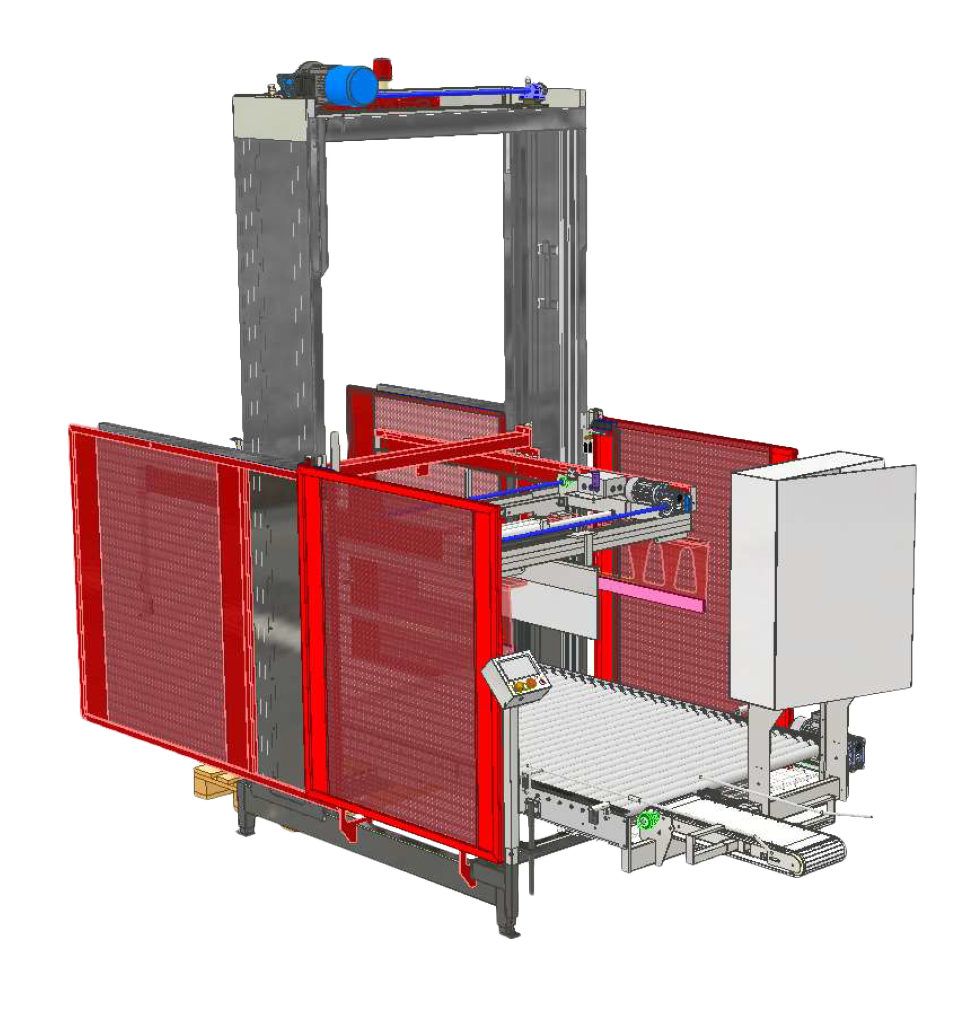
Traditional simple layer palletizers have been the backbone of the industry for decades. They are known for their robustness and reliability, capable of handling high-speed operations with ease. These machines are designed to stack products in specific patterns onto a pallet, making them ideal for businesses with high-volume, uniform product lines. They are also easier to troubleshoot, support, and operate without special training. A single unit can handle up to 2 -3 SKU’s simultaneously, and they typically cost less than a robotic palletizer with a single or dual infeed. Their speed can range up to 15 cases/min for low-level palletizers and up to 150 cases/min for high-level palletizers.

Modern robotic palletizers

On the other hand, modern robotic palletizers offer flexibility and adaptability. They are capable of handling a wide variety of product types, including cases, bags, pails, bottles, batteries, cubes of scrap metal, and plastic containers. They can adapt easier to accommodate different pallet patterns and product types, and can handle up to 1000 kg (2,200 lbs). A single articulated arm can typically handle up to 4 different SKU’s, and if the articulated arm is attached to a moving track or a gantry style robot is utilized, 8 to 12 SKU’s can be handled simultaneously by a single robot. Robotic palletizers also have the advantage of taking up less space, and their price can sometimes be less, especially when looking at four or more simultaneous infeeds. Their palletizing rates can vary anywhere from 8 to 30 cases/min for a single robot depending on stacking patterns, requirements, and if the robot is picking a single product, rows of product, or full layer of products.


In conclusion

Both traditional simple layer palletizers and modern robotic palletizers have their unique advantages. The choice between the two should be based on the specific needs of the business, considering factors such as product type, volume, space, and budget. We are here to help you get the most efficient and best fitting solution for you particular business process. If you need any assistance we can help you based on our vast experience and even create a ROI estimation on your specific situation.

The Palletizer Book 2023

Top 10 Most Frequently Asked Palletizing Industry Questions, Answered (2023)


Palletizers have become a staple for many manufacturing businesses around the world. The power and versatility of these machines has revolutionized several industries by increasing productivity while improving safety standards in the workplace. Their characteristics and features allow for a wide array of products to be stacked and shipped more quickly and securely than ever before.

We’ve rounded up the most frequently asked questions we encountered on the web and answered them to create this helpful overview of what palletizing is all about.

Table of contents

Contents

Top 10 Most Frequently Asked Palletizing Industry Questions, Answered (2023) 1

  1. What Is a Palletizer?. 1
  2. What Is the History of Palletizing Systems?. 2
  3. What Are the Types of Palletizers?. 3

3.2 Conventional Palletizers – The Speedy Solution. 3

3.2.1 High-level palletizers. 4

3.2.2 Low-level palletizers. 4

3.3 Robotic Palletizers – The Versatile Solution. 4

3.3.1 Basic Robotic Systems. 5

3.3.2 Fully Automatic Robotic Systems. 5

3.4 Hybrid Palletizing – Great for Specific Applications. 6

  1. What Are the Key Differences Between Conventional and Robotic Palletizers?. 6
  2. What Are Robot End Effectors and End-of-arm Tooling (EOAT)?. 7

5.1. What Is an End Effector?. 7

  1. Types of Pallets. 8
  2. What Are the Benefits of Palletizers?. 9
  3. What Is a Unit Load?. 10
  4. What Is the Role of a Palletizer Operator?. 12
  5. How Much Does a Palletizer Cost?. 13


1. What Is a Palletizer?
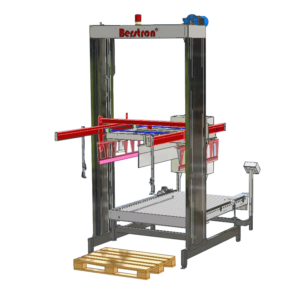
A palletizer is a machine that arranges and stacks products onto pallets in order to create a stable unit load for transportation and storage. The terms palletizer or unitizer may be used interchangeably. That being said, there is a small distinction between the two; palletizers typically place loads on a pallet, while unitizers may place loads on a sheet or directly on a conveyor. Either way, these come in two main functioning methods:

1.1 Conventional Palletizers

Conventional palletizers handle products such as bags or cases that are fed into the machine. Units are positioned to create layers and then stacked to create a complete unit load. Conventional palletizers consist of standard components that include:

  • A pallet dispenser
  • Infeed conveyors,
  • Case turners
  • Layer-forming tables
  • Full load hoist
  • Slip sheet dispensers (optional)


1.2 Robotic Palletizers

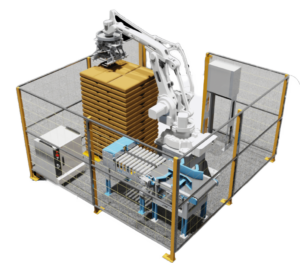
Robotic palletizers function in a similar way with differing components. The key difference is that robotic palletizers utilize robotic arms, which pick up the units and stack them onto the pallets. There are, however, some hybrid models that incorporate both palletizing styles within one machine.

Overall, palletizers are programmed to configure pallet patterns, or in other words, the optimal disposition of products to be well protected and stable during transport or storage. Conventional palletizers specialize in creating cubed loads, whereas robotic palletizers specialize in precise pattern formation. These patterns are programmed into the system and stored as recipes, which can be called up and even edited with a few clicks on a human-machine interface (HMI).

At its core, the palletizing process is the stacking of products to make shipping and storing more efficient. The creation of a well-cubed loads through specific pallet patterns allows businesses to ship more products with less loss due to damage.


2. What Is the History of Palletizing Systems?
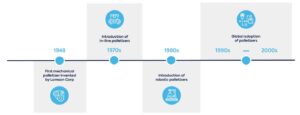
Transporting and storing products on pallets became a standard during World War II. Shortly after, in 1948, the first mechanical palletizer was invented for the military by Lamson Corp. This was done in an effort to increase productivity and relieve the physical strain of workers from manually stacking boxes onto pallets. The first commercial palletizer was built for Coca-Cola by George vonGAL, founder of vonGAL Palletizers, in 1957.

As global shipping started to evolve in the 1970s, demand for enhanced operational efficiency was needed, for which the in-line palletizer was introduced. This machine used conveyors to guide products to a layer-forming table, which then stacked the products onto the pallet.

Then, the 1980s saw the introduction of computers and robotics in the workplace. This innovation brought the creation of robotic palletizers to further increase productivity and precision in the industrial sector.

The 2000s were marked by the high adoption rate of companies acquiring robotic palletizers to meet the rising demand of the market. As more and more industries adopted robotic palletizers to improve their workflow, a variety of end of arm tooling had been invented so that robotic palletizers could solve specific problems.

Conventional palletizers have also evolved over the years and are still very competitive in today’s market. While robotic palletizers have the advantage of precisely forming certain patterns, conventional palletizers have the upper hand in terms of speed and throughput. Either type of system could suit your needs depending on the product being palletized and operational requirements.


3. What Are the Types of Palletizers?

3.1 Manual and Semi-automatic Palletizers – Where It All Started


Manual Palletizer – Vacuum Lifter

A manual palletizer may simply be moving product by human force or it might consist of a system that helps humans to manually stack products on a pallet. These systems can take the form of a conveyor and pallet lift table or a vacuum lifter. The pallet lift allows the height of the pallet to be adjusted so the operator can easily place each unit onto the pallet.

The second type would be a vacuum-assist lifter. Vacuum lifters are hung from a fixed or mobile metal rack, or hung from the ceiling, using a long tube with a suction cup at the end. This latches onto products gently and securely with a fraction of the normal physical effort it takes to move them to their desired location. The benefit of using this type of system is reducing physical strain and workplace injury.

Manual palletizers represent a cost-effective solution, but there are still limitations in terms of throughput speed and they always require labor.


3.2 Conventional Palletizers – The Speedy Solution

Conventional palletizers are fully automatic systems that receive products (bags, bales, boxes, trays, etc.), form layers and stack them into a unit load. These machines operate very quickly and are suited for a single SKU at a time. Pallet load patterns and configurations are selected on a screen called a human-machine interface (HMI). Current systems may be tied to a warehouse management system to change SKUs and patterns on the fly.

This type of palletizer consists of high performance machines that have the ability to process up to 40 bags or 200 cases per minute. The traditional mechanics of the system means that very little special knowledge is required to properly maintain these machines. Conventional palletizers can produce stable pallets, which save space for warehousing or transit.

There are two types of conventional palletizers: high-level and low-level systems. The choice between these two options depends on the configuration of your plant and the required throughput.


 3.2.1 High-level palletizers

High-level palletizers are fed by a metering belt conveyor with items such as boxes, bags, or trays from the top of the machine; typically seven to eight feet in the air. The operator platform is also located at the top of the machine and the machine’s entire perimeter is secured with hand rails.

The products are arranged in the proper configuration in the row forming area and pushed onto the layer forming table. These layers are formed on an apron that opens over the hoist. The hoist is responsible for raising and lowering the pallet to allow the layers to stack on top of one another. Once the pallet load is completed, it is either picked up by forklift or moved away by conveyors.


3.2.2 Low-level palletizers

The main difference between the high-level and low-level palletizer is the infeed point. While high-level machines typically receive products around eight feet above the floor, low-level machines receive products around three feet above the floor. Rows and layers are built in the same fashion. Once a layer is formed, it is lifted to the top of a pallet and placed as the apron slides away. Due to this extra motion, low-level palletizers are often slower than their high-level counterparts.

Both low-level and high-level conventional palletizing systems offer great reliability and longevity. From a high quality provider, these machines can have up to 99% uptime. In terms of their technical lifetime, some systems remain operational for several decades with proper maintenance.


3.3 Robotic Palletizers – The Versatile Solution

Robotic palletizers use a robotic arm that lifts the products either one by one or in batches, stacking them on a nearby pallet. With this type of process, products can be palletized either one at a time, by row, or by layer depending on the type of end-of-arm tooling. These robots can also be equipped with vision systems to stack products very precisely and even overlap bags.

Advanced models can be equipped with a slip sheet dispenser, a pallet dispenser, and an exit pallet conveyor to move the load to the pallet wrapping machine. These features improve the utilization and speed of the machine. Compared to conventional palletizers, they also provide great handling and versatility thanks to the end of arm tooling and software.

Robotic palletizers are also extremely reliable with MTBF (Mean Time Between Failure) rates, reaching up to 80,000 hours. Additionally, they have very short MTTR (Mean Time To Repair) rates. Having both a reliable palletizer supplier and the appropriate spare parts in inventory significantly increase uptime.

Although there is a wide range of configurations of robotic palletizers, here are two examples at each end of the spectrum:

3.3.1 Basic Robotic Systems

The most basic versions of robotic palletizers include:

  • An infeed conveyor
  • A robotic arm
  • An end-of-arm tooling
  • Security fences

Obviously, the entry-level models will have more basic functionalities since they aren’t equipped with slip sheet or pallet dispensers, and the pallet will be located on the floor. Instead of being moved onto conveyors, the pallet would be picked up by a hand truck or forklift and manually replaced. Every time a pallet needs to be replaced, the robotic palletizer’s operations must be paused until an empty pallet is replaced.


3.3.2 Fully Automatic Robotic Systems

Fully automatic palletizers come with:

  • An infeed conveyor
  • A robotic arm
  • An end effector
  • A pallet dispenser
  • A slip sheet dispenser
  • Security fences

The palletizing process begins with an entry conveyor, which carries the products to the robotic arm while the pallet dispenser carries an empty pallet to the palletizing station. Then, the slip sheet dispenser layers a sheet over the pallet for the robotic arm to load the items. Once the empty pallet and the slip sheet are in place, the robotic arm starts picking and placing the items from the entry conveyor to the pallet until the pallet is fully loaded.

The exit conveyor moves the loaded pallet towards a stretch wrapping station. A forklift is then used for storage or transit, after which the process starts all over again. A great benefit of the fully automatic robot palletizer is that the pallet magazine can be refilled without stopping the system’s operations.

Some automatic palletizing systems replace the standard robotic arm with a cobot, which stands for collaborative robot. Cobots collaborate with plant staff instead of substituting them. Cobots add great value to a palletizer because it increases safety for all the employees surrounding the palletizer, as there are sensors in the arm that detect whether any people or objects are in its surroundings.


The main benefit is that cobots enable staff to work alongside the machine safely and maximizes floor space. It removes the need for any security fencing around the palletizer. The main disadvantages of Cobots compared to the standard robotic arms is in terms of efficiency. They have significantly lower weight capacities and do not operate as quickly.


3.4 Hybrid Palletizing – Great for Specific Applications

Hybrid palletizing refers to the combination of high-level conventional and robotic palletizers on a single production line to achieve a custom palletizing process. The hybrid palletizer will generally utilize robotic arms  to feed a conventional palletizer and form layers. Once the layer is formed, the apron on which it sits releases the load onto the pallet hoist. Finally, the palletized unit load moves along the conveyor to be wrapped, stored or transported.Hybrid palletizers are best for certain scenarios where a customized option is required. For instance, if the required throughput rate for your operation’s needs is significantly higher than what robotic palletizers offer, then the hybrid variety may be for you. If overlap is required for the products you are palletizing, that would be another great reason to opt for a hybrid palletizer.


4. What Are the Key Differences Between Conventional and Robotic Palletizers?

Conventional and robotic palletizers share some common utility, while also having their own distinct use cases and advantages. They vary in terms of:

  1. Versatility in the types of products handled
  2. Productivity
  3. Maintenance requirements
  4. Safety
  5. Cost
  6. Floor space


The table below compares the capabilities of both conventional and robotic palletizing systems:

   
    Conventional Robotic
Products Handled & Versatility Handles 1 SKU at a time.
Adapted for cases, bags, bales, trays, etc.
Handles 1 or multiple SKUs at a time.
Adapted for virtually any type of product.
Productivity Cases: up to 200/min
Bags: up to 40 per minute
Cases: Up to 80/min.
Speed varies depending on the configuration and quantity of products handled per pickup.
Bags: Up to 40/min
Maintenance & Training Slightly more maintenance, less training required Cases: Up to 80/min.
Speed varies depending on the configuration and quantity of products handled per pickup.
Bags: Up to 40/min
Safety Slightly more maintenance, less training required Trapped key interlocking
Fences
Light curtains
etc.
Cost $-$
Price varies mostly depending on the speed of the equipment
$-$$
Price varies mostly depending on the level of automation, the type of product handled, and the speed. Custom solutions are available and tend to be more expensive.
Footprint Slightly smaller footprint than equivalent robotic systems. Slightly larger footprint than comparable conventional palletizers, compensates with modularity.


5. What Are Robot End Effectors and End-of-arm Tooling (EOAT)?

5.1. What Is an End Effector?

End-of-arm-tooling (EOAT), also known as end effectors, refers to the various tools that can be installed at the end of a robotic palletizer arm. They allow the machine to handle:

  • Bags
  • Jugs
  • Cases
  • Trays
  • Bottles
  • Cans
  • Bales
  • Bundles
  • Pallets
  • Totes

End effectors can be swapped out to do multiple jobs and are often made for specific product types or situations. Let’s look at the most common types that are used.


6. Types of Pallets

Pallets come in a variety of shapes and materials, and choosing the correct one is an important aspect of the palletizing process. Here are the most common pallet types in the industry:

6.1 Pallet Styles

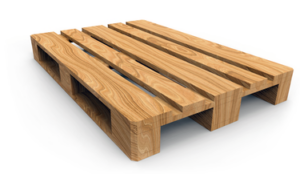
6.1.1 Block Pallets

These pallets have four points of entry so forklifts can use them from all sides. They can be made out of wood, plastic or plywood and they get their name from the 9 blocks of material that form the structure of the pallet.


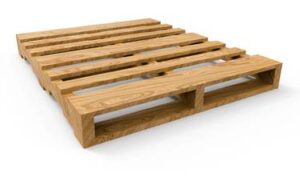
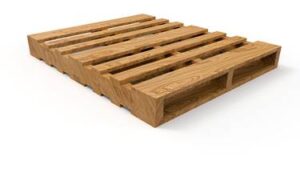
6.1.2 Stringer or GMA Pallets

These pallets get their name from the 3 planks of wood that hold the slats. Stringer, or GMA pallets, may be designed as either two-way or four-way pallets, depending on whether or not they have notches. You may also see some where the top boards extend past the stringer. These are referred to as Winged-Pallets and are primarily used in the military.


6.1.3 Solid Deck Pallets

These pallets don’t have slatted tops, but instead, have a full square of plastic or wood, sometimes with small openings to allow for drainage. They are often used for products that don’t need the aeration or drainage of a regular pallet, but instead require added protection.


6.1.4 Double-Faced Pallets


All the previously mentioned pallets can come in a double-faced version. This simply means they have slats positioned across at the top and bottom of the pallet, whereas a regular pallet only has slats on one side. This design allows for more versatility and speed since the pallet can be used from either side and no time is wasted flipping it into position. This also makes the pallet much more structurally sound for heavier loads.


Pallet Sizes

Standard pallet 48’’ x 40’’

This is the standard pallet type across North America and comprises 30% of the market. It has dimensions of  48 x 40 inches and a safe working load of up to 4,600kg


Euro pallet 1200 x 800

This pallet style is the standard across European countries, it’s a 4-way pallet in a rectangular shape with dimensions of 1,200 mm × 800 mm × 144 mm and a safe working load of 1,500kg


Industry pallet 1200 x 1000

Another common pallet size in Europe used for larger loads.


Half pallet 800 x 600

This type of pallet is used for smaller loads that wouldn’t fill a full pallet but still need to be shipped. They follow the standard of a pallet in their region, which means in North America a half pallet is 40 x 24 inches and 800 x 600 mm in Europe.


7. What Are the Benefits of Palletizers?


The Advantages of Palletizers:

  1. Efficiency

The throughput is incomparable to manual solutions, as palletizing machines can process up to 200 units per minute. A palletizer with proper maintenance can run 3 shifts a day for many decades and achieve very high production rates throughout its life.

  1. Safe workspace

Loading pallets manually is strenuous work that is inherently dangerous to the human body if done long enough. Using a palletizer to load products gives your employees a better quality of life and reduces the risk of injury by reducing repetitive movements.


Most palletizers are equipped with safety features such as light-curtains at entry and exit points that trigger the machine to stop if an object is detected. Trapped key interlockings, which are a series of locks placed on palletizers, require a key to be removed from the HMI and placed in the gate lock in order to operate specific portions of the machine. This ensures operators are kept safe and unable to access dangerous areas while the palletizer is in motion.

  1. Unit load consistency

When palletizing is done by a human, there’s a higher margin of error than a system that has been programmed to execute the task at hand. The consistency of conventional or robotic palletizers allows them to produce loads that are compact, shaped, and stable. Properly palletized loads reduce damaged products during transportation within the plant or during shipment.


8. What Is a Unit Load?

A unit load is a set of items such as boxes, trays, or bags, that are set and wrapped onto a pallet or slip sheet in various patterns. It ensures stability, even weight distribution, and the smallest possible footprint with the purpose of being handled as a single unit for warehousing or transit. The unit load may be wrapped manually or automatically by a stretch wrapping machine or a hooding machine.


A palletized unit load consists of 4 core elements:
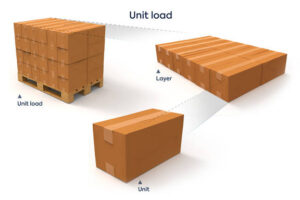
Unit: A single item such as a bag, box, bale, jug, tray, etc.

Row: A set of items configured in a straight line.

Layer: A set of rows side-by-side and parallel to each other forming a layer.

Unit load: Layers that are stacked on top of one another in varying pattern configurations and then stretched wrapped, forming a new single unit.

The three most common pallet patterns are brick, pinwheel and block. Brick and block are mostly used for cases, while pinwheel patterns are more often used for bags. These patterns not only provide more steadiness to the load, but also ensure the products remain in an efficient square shape and under the height requirements of transporters to fit in trucks.


Let’s take a look at each unit load pattern type
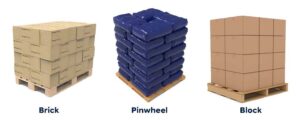
Brick or Interlocked: The units are placed in parallel along the edges and perpendicularly at the corners of the pallet, continuously until the layer is filled, creating a circular brick-style layout. The brick method is also very space efficient, having no gaps and is extremely stable as the boxes are facing different directions, reducing the overall risk of them falling.


Pinwheel pattern: The individual units, or sets of 2-3 depending on the size, are positioned perpendicular to one another in the form of a pinwheel. The pinwheel method is used for boxes, but more often bags, especially when four is the ideal number for the layer. Bags benefit from this because they are soft and their dimensions can slightly vary in shape, making the pinwheel a desirable arrangement. This pattern is very stable because the units are facing different directions, reducing the chances of slippage.


Block or Column Pattern: The units are uniformly stacked with one another, perfectly aligned both horizontally and vertically. Boxes stacked with the block pattern method are extremely space-efficient and are relatively stable so long as the weight of the units are equal.

Here are some tips to avoid in terms of patterns and unit load:

  • Avoid creating a palletized unit load with a pyramidal shape, because the unit distribution will be uneven, creating an unstable load with high risk of the items in the upper layers falling.
  • Minimize gaps to not only maximize space usage, but also to reduce the risk of the units moving within the load. There are situations when gaps could be required, such as for products that require some cooling or condensation reduction.
  • Properly secure the load to the pallet with the correct type of film and wrap pattern.


9. What Is the Role of a Palletizer Operator?

Palletizers, whether conventional or robotic, are designed to not have constant supervision because automation is the ultimate goal and is the case with automatic palletizers. If it is a semi-automatic robot, where pallets are constantly loaded and unloaded, then an employee must be there constantly. Essentially, the higher end the robot, the less supervision is required.

For most operations, the palletizer operator role isn’t necessarily a dedicated one, as the knowledge required isn’t too demanding once the palletizer is built and configured. For instance, a stock person, fork truck driver, or a warehouse supervisor could also be responsible for operating the palletizer. However, when there are multiple machines involved, this increases the need for a dedicated operator.

A palletizer operator selects a pattern configuration that has already been stored on the Human-Machine Interface at a push of a button. They also ensure that there are enough pallets and slip sheets in the magazines for all the loads being created. The operator must perform routine checks to ensure that the equipment is fully operational. Fully loaded pallets are then moved to storage or loaded for transit, typically with a forklift or pallet jack.

If the product on the line changes, then the operator must go into the HMI and reprogram it according to the new product. Lastly, maintenance is a key role in the palletizer operator’s job description, as they may have to replace certain components and clean the equipment when necessary.

Learning to work on these machines can be done by any employee given the proper training. When shopping for palletizers, it is crucial to ask vendors about their training programs. They should have a well-defined series of lessons to bring your employees up to speed on the machine you purchase.

10. How Much Does a Palletizer Cost?

A palletizing system’s total cost of ownership depends on operational needs in terms of:

  • Required throughput speed
  • Level of automation
  • End of arm tooling
  • Sensors
  • Conveyors
  • Integration
  • Maintenance costs, etc.

Pricing will also vary on whether the system will be manual, conventional, robotic, or hybrid.

Palletizing machines are a long term investment, which includes many factors to consider when making such a purchase. One of these being the upfront cost of the machinery, including shipping, duty, taxes, installation, and employee training. Another is the material and overhead costs, such as electricity, depreciation, and other utilities, which should all be factored into the total cost of ownership. Lastly, upkeep and maintenance costs, along with spare parts, should also be held into account.

The average prices of palletizer machines can vary significantly depending on several factors such as the type of palletizer, its capacity, features, brand, and market conditions. Here are some approximate average prices for different types of palletizer machines as of my knowledge cutoff in September 2021:


Semi-Automatic Palletizer: Semi-automatic palletizers partially automate the palletizing process, often incorporating features like robotic assistance or mechanical assistance for lifting and stacking products. The average price range for semi-automatic palletizers is generally between $10,000 and $50,000.


Automatic Palletizer: Automatic palletizers are fully automated systems that can handle high-volume palletizing tasks with minimal human intervention. They can include advanced features such as robotic arms, conveyors, and integrated software for optimized palletizing. The average price range for automatic palletizers can vary significantly depending on the complexity and capacity but typically starts around $50,000 and can go well beyond $1 million for large-scale, high-capacity systems.


It’s important to note that these price ranges are approximate and can vary based on several factors such as customization, additional features, brand reputation, and geographic location. For up-to-date and accurate pricing information, it is recommended to consult manufacturers, suppliers, or industry experts specializing in palletizing equipment.

We are always available to help you calculate an ROI estimate for your particular situation. You can contact us at our website www.berstron.com , Mail marcvanoers@berstron.com or phone/WhatsApp +34 666491154


Optical Tomato Grading and Sorting: Answering Your Top Questions

Optical Tomato Grading and Sorting: Answering Your Top Questions


Contents

 Optical Tomato Grading and Sorting: Answering Your Top Questions. 1

 Executive Summary. 1

  1. What is Optical Tomato Grading and Sorting?
  2. How Does Optical Tomato Grading and Sorting Work?
  3. What Are the Benefits of Using Optical Tomato Grading and Sorting?
  4. How Does Optical Tomato Grading and Sorting Improve Efficiency in the Production Process?
  5. How Does Optical Tomato Grading and Sorting Contribute to Improved Product Quality?
  6. How Does Optical Tomato Grading and Sorting Help in Reducing Costs in the Production Process?
  7. What Are the Technical Characteristics of Optical Tomato Grading and Sorting Systems?
  8. How Is the Performance of Optical Tomato Grading and Sorting Systems Evaluated?
  9. What Components Are Included in an Optical Tomato Grading and Sorting System?
  10. How Can Optical Tomato Grading and Sorting Systems Be Implemented in Existing Production Processes?
  11. What Are the Expected Financial and Production Volume Benefits?

In conclusion, 4


Executive Summary


This blog post delves into the innovative world of optical tomato grading and sorting, a technology-driven process that is revolutionizing the agriculture industry. Utilizing high-resolution cameras and advanced software algorithms, these systems automate the sorting of tomatoes based on size, color, and defects, ensuring a high level of accuracy and efficiency.


The benefits of optical tomato grading and sorting are manifold. It increases the speed of the sorting process, improves the quality of the final product, and reduces costs by eliminating the need for manual labor. Systems like Berstron’s can process up to 20 fruits per second, significantly increasing production efficiency.


The implementation of these systems in existing production lines is straightforward, with components including a host computer, ejector cards, weight cards, and SmartFruit cameras. The financial and production volume benefits of these systems are substantial, leading to higher production volumes, increased revenues, and significant cost savings.


In conclusion, optical tomato grading and sorting is an invaluable tool for any producer looking to increase efficiency, improve product quality, and stay competitive in today’s market.

As technology continues to evolve, it’s transforming the way we approach agriculture. One area where this is particularly evident is in the grading and sorting of produce. Today, we’re going to delve into the world of optical tomato grading and sorting, answering the most common questions about this innovative technology. We’ll use Berstron’s visual sorting system as a reference, a leading solution in the market.


 1. What is Optical Tomato Grading and Sorting?


Optical tomato grading and sorting is a technology-driven process that uses cameras and software algorithms to sort tomatoes based on specific criteria such as size, color, and defects. This process is automated, ensuring a high level of accuracy and efficiency.


 2. How Does Optical Tomato Grading and Sorting Work?


Optical grading and sorting systems, like Berstron’s SmartFruit camera module, use high-resolution cameras and LED lighting to capture images of each tomato as it passes through the system. These images are then analyzed by software that can identify the size, color, and any defects present in the tomato. Based on this analysis, the system sorts the tomatoes accordingly.


 3. What Are the Benefits of Using Optical Tomato Grading and Sorting?


The benefits of using optical tomato grading and sorting are numerous. It increases the efficiency of the sorting process, improves the quality of the final product, and reduces costs. By automating the process, it eliminates the need for manual sorting, which can be time-consuming and prone to errors.


 4. How Does Optical Tomato Grading and Sorting Improve Efficiency in the Production Process?


Optical tomato grading and sorting systems can process a large number of tomatoes quickly and accurately. Berstron’s system, for example, can handle up to 20 fruits per second in vision mode and up to 12 fruits per second in weight mode. This high-speed processing significantly reduces the time it takes to sort tomatoes, increasing the overall efficiency of the production process.


 5. How Does Optical Tomato Grading and Sorting Contribute to Improved Product Quality?


By using high-resolution cameras and advanced software algorithms, optical tomato grading and sorting systems can identify and sort out tomatoes with defects that might not be visible to the naked eye. This ensures that only high-quality tomatoes make it to the final product, improving the overall quality of the produce.


 6. How Does Optical Tomato Grading and Sorting Help in Reducing Costs in the Production Process?


By automating the sorting process, optical tomato grading and sorting systems reduce the need for manual labor, which can be a significant cost in the production process. Additionally, by improving the quality of the final product, these systems can reduce the costs associated with product returns or rejections due to poor quality.


 7. What Are the Technical Characteristics of Optical Tomato Grading and Sorting Systems?


Optical tomato grading and sorting systems, like Berstron’s, are equipped with high-speed, high-resolution digital cameras, LED lighting systems, and powerful processing units. They are designed to be easy to install and use, with a user-friendly graphical interface.


 8. How Is the Performance of Optical Tomato Grading and Sorting Systems Evaluated?


The performance of optical tomato grading and sorting systems is evaluated based on their speed, accuracy, and the quality of the final product. The best systems are those that can process a large number of tomatoes quickly and accurately, while ensuring that only high-quality tomatoes make it to the final product.


 9. What Components Are Included in an Optical Tomato Grading and Sorting System?


An optical tomato grading and sorting system typically includes a host computer, ejector cards, weight cards, SmartFruit cameras for vision gauges, and camera mounts and LED lights for vision gauges


 10. How Can Optical Tomato Grading and Sorting Systems Be Implemented in Existing Production Processes?


Implementing an optical tomato grading and sorting system in an existing production process is a straightforward process. The system can be installed along the existing production line. The SmartFruit cameras, for example, are designed to be easily mounted on a 60mm square tube, without the need for screws. Once installed, the system can be connected to the host computer and is ready to start sorting.


 11. What Are the Expected Financial and Production Volume Benefits?


The financial and production volume benefits of implementing an optical tomato grading and sorting system can be substantial. By increasing the speed and accuracy of the sorting process, these systems can significantly increase the volume of tomatoes that can be processed in a given time. This increased efficiency can lead to higher production volumes and, consequently, higher revenues.


Furthermore, by reducing the need for manual labor and improving the quality of the final product, optical tomato grading and sorting systems can lead to significant cost savings. These savings can be realized in the form of reduced labor costs, lower costs associated with product returns or rejections, and less waste due to fewer defective products.


In conclusion,


Optical tomato grading and sorting is a game-changing technology in the world of agriculture. It brings efficiency, quality, and cost-effectiveness to the table, making it an invaluable tool for any producer looking to stay competitive in today’s market. With companies like Berstron leading the way, the future of tomato grading and sorting looks bright indeed.


Click here to read what we can do to help you getting your Grading & Sorting automated

10cm High Speed Electronic Labeller

Supercharge Your Labeling Process with the ETQ-100 High Speed Electronic Labeller

In today’s fast-paced business environment, efficiency is key. For businesses that involve packaging and labeling, the speed and accuracy of the labeling process can significantly impact productivity and profit margins. One product that promises to enhance the efficiency and speed of your labeling process is the ETQ-100 High Speed Electronic Labeller from Berstron.

Power and Efficiency

The ETQ-100 is not just an ordinary label dispenser. It is designed to be a robust and efficient tool that helps you get the most out of your labeling process, whether you’re applying labels to fruits or any other items.

The machine is designed with intelligence at its core. Upon a slight tap to the product with the business end of the machine, a label is applied and the machine immediately readies the next label. This is made possible by the inbuilt intelligence that scans the size of your label and feeds the appropriate amount to present the next label.

High Speed, High Volume

Berstron’s ETQ-100 High Speed Electronic Labeller is designed to handle high volumes with ease. It can apply up to 5 labels per second, translating to 18,000 labels per hour. The machine is quicker than its operator, capable of handling an impressive workload in your labeling process【5†source】. This can significantly speed up your operations and enable you to meet high demand in a timely manner.

Battery Life and Specifications

The ETQ-100 comes with a 7.2V Lithium-Ion battery, which ensures a full day of labeling on a single 6-hour charge. This means your labeling process can continue uninterrupted for longer periods.


https://youtu.be/G9UDEgvXmcc

Other specifications of the ETQ-100 High Speed Electronic Labeller include:

– SKU/Type: ETQ-100
– Weight: 1.4 Kg
– Maximum Label Width: 100 mm
– Label roll size: Core minimum 40 mm – Outside maximum 135 mm
– Charger: 100-220v / 12V 2A
– Effective usage: 6 to 8 hours of continuous labeling.

In terms of shipping dimensions, the ETQ-100 measures 40 × 50 × 15 cm and weighs 2 kg.

Conclusion

Investing in the right tools can dramatically enhance your productivity and profitability. The ETQ-100 High Speed Electronic Labeller from Berstron is one such tool that promises to transform your labeling process. With its impressive speed, efficiency, and battery life, this machine is built to handle high-volume labeling tasks with ease. Whether you’re labeling fruits or any other items, the ETQ-100 is designed to supercharge your labeling process and help your business grow.

Ready to order? click this link to view this item in our shop here

All you need to know about Sinclair International Labeling System


All you need to know about Sinclair International Labeling System


Contents

About Sinclair International

  1. Innovation
  2. Customization
  3. Food Safety
  4. Sustainability
  5. Global Presence


How does a company benefit from this system?

  1. Brand Identity
  2. Customer Support
  3. Technical Service
  4. Variety of Labels
  5. Labeling Systems


Top 5 reasons to invest in the Sinclair International Labeling System

  1. Innovative Technology
  2. Customized Solutions
  3. Compliance with Regulations
  4. Global Expertise and Support
  5. Sustainability


Pros and Cons of the Sinclair International Labeling System

High-Speed Electric Hand Labeler – Sinclair


About Sinclair International

Sinclair International offers a comprehensive range of labeling solutions designed to meet the diverse needs of businesses in the food industry. Their innovative labeling systems and high-quality labels are designed to enhance brand visibility, ensure food safety, and streamline operations.

Sinclair’s labels come in a wide array of shapes, sizes, and styles, all custom-designed to complement your branding. They offer compostable labels, larger labels for bigger produce like watermelons and pumpkins, non-tab labels, tabbed labels, clear labels, variable print labels, and special application labels. Each label type is designed with specific features to cater to different produce and branding requirements.

For instance, their compostable labels are suitable for automated, high-speed labeling systems or hand-applied labeling operations, helping businesses achieve a sustainable labeling operation. Their larger labels, compatible with Sinclair’s V6 technology, are perfect for promoting your brand in a big way. Sinclair’s variable print labels, enabled by their patented and award-winning Print On-Demand technology, allow printing of variable information at the point of application while fruits and vegetables are conveyed at high speeds in the packinghouse.

Sinclair’s labeling systems are equally impressive. They offer on-line labeling systems, which are the best option for labeling fruit and vegetables in bulk. These systems can reliably apply labels at a range of speeds customized to your application. Their Print on Demand system simplifies produce label inventory by printing variable information at the point of application. Additionally, their pattern labelers are packed with innovative features and are the optimal solution for labeling in trays, inner trays, or punnets at a number of speeds customized to your application.

  1. Innovation: Sinclair International has a strong dedication to innovation, continuously improving their products and services. They have pioneered the development of patented technology in automatic high-speed fruit-labeling systems for individual pieces of fresh produce, often running at 12 fruit per second.


  1. Customization: Sinclair offers a robust selection of customized solutions to serve different labeling needs. They provide support, service, and a lasting partnership, customizing an entire solution to fit operational, geographic, and business requirements.


  1. Food Safety: Sinclair ensures every label they make is compliant with key global regulations, making food safety an operating principle. Their labels are food-safe and comply with requirements of the U.S. Food and Drug Administration (FDA) and the European Union (EU).


  1. Sustainability: Sinclair works to minimize environmental footprints in everything they create. They are committed to the environment, minimizing their footprint as much as possible.


  1. Global Presence: Sinclair has a global presence with 9 label-manufacturing sites around the world and labeling systems installed in more than 45 countries worldwide.


How does a company benefit from this system?


  1. Brand Identity: Sinclair’s labeling system allows companies to showcase their brand identity and differentiate themselves.


  1. Customer Support: Sinclair provides unmatched customer support, delivering global expertise locally.


  1. Technical Service: Sinclair’s technical service is recognized as a leader in providing support, consultative technical advice, and analysis for optimal labeling efficiency.


  1. Variety of Labels: Sinclair offers a variety of labels, including compostable labels, larger labels, non-tab labels, tabbed labels, clear labels, variable print labels, and special application labels.


  1. Labeling Systems: Sinclair manufactures customized labeling systems for every application including high-speed, singulated, tray labeling, and compact pattern labeling.


Top 5 reasons to invest in the Sinclair International Labeling System:


  1. Innovative Technology: Sinclair’s patented technology in automatic high-speed fruit-labeling systems is a game-changer in the industry.


  1. Customized Solutions: Sinclair’s ability to provide customized solutions based on specific operational, geographic, and business requirements makes it a versatile choice for businesses.


  1. Compliance with Regulations: Sinclair’s commitment to food safety and compliance with global regulations ensures that businesses using their labels meet necessary standards.


  1. Global Expertise and Support: Sinclair’s global presence and unmatched customer support ensure that businesses receive the necessary assistance whenever and wherever they need it.


  1. Sustainability: By choosing Sinclair, businesses also support sustainability efforts, as Sinclair strives to minimize environmental footprints.


Pros and Cons of the Sinclair International Labeling System:


Pros:


  1. High-speed labeling capabilities.
  2. Compliance with global food safety regulations.
  3. Customized solutions to fit specific business needs.
  4. Strong customer support and technical service.
  5. Commitment to sustainability.


Cons:


  1. The cost could be higher than other less advanced systems.
  2. The system might require training to operate effectively.
  3. Depending on the business’s location, there might be delays in customer service due to time zone differences.


The Sinclair International Labeling System is compatible with a variety of machines. One such machine is the High-Speed Electric Hand Labeler offered by Berstron. Here’s a brief description of the machine:


High-Speed Electric Hand Labeler – Sinclair

https://youtu.be/YxZT2UKsNjo

(This video depicts the normal labels but functions the same as the Sinclair Labeller)


This hand labeler is designed for quick, reliable, and efficient labeling of fruits and other products. It is 100% compatible with Sinclair labels. The machine is designed for ease of use and high-speed operation, allowing for efficient labeling processes in a variety of settings.


Here are some key features and specifications of the High-Speed Electric Hand Labeler:


– Weight: 690 gr

– Dimensions: 30 × 22 × 6 cm

– Width: Available in 25 mm

– Price: 1,129.00 €

– Stock: 594 in stock (can be backordered)

Click here to order your labelers today 


This hand labeler is a practical choice for businesses that require a high-speed, reliable, and efficient solution for labeling fruits and other products. It’s particularly beneficial for operations that need to process large quantities of products in a short amount of time.


As for other machines that use Sinclair labels, Sinclair manufactures customized labeling systems for every application including high-speed, singulated, tray labeling, and compact pattern labeling. For more specific information about these machines, it would be best to contact Sinclair International directly or visit their website.

Top 10 most asked questions about tractor add-on kits

Top 10 most asked questions about tractor add-on kits


Contents

  1. What is a tractor add-on kit?
  2. How does a tractor add-on kit work?
  3. What are the benefits of using a tractor add-on kit?
  4. Can any tractor be converted with an add-on kit?.
  5. How difficult is it to install a tractor add-on kit?
  6. How does a GPS-guided tractor add-on kit improve farming efficiency?
  7. What is the cost of a tractor add-on kit?
  8. How long does it take to install a tractor add-on kit?
  9. Can a tractor add-on kit be removed if not needed?
  10. Where can I buy a tractor add-on kit?


Now, let’s dive into these questions in more detail.


 1. What is a tractor add-on kit?


A tractor add-on kit is a set of components designed to upgrade traditional tractors with modern features. These kits can include GPS guidance systems, hydraulic systems, and other advanced technologies. Berstron’s add-on kits, for example, convert traditional tractors into GPS-guided modern tractors, enhancing their functionality and efficiency.


 2. How does a tractor add-on kit work?


A tractor add-on kit works by integrating with the existing systems of the tractor. For instance, a GPS-guided add-on kit uses GPS technology to guide the tractor, reducing the need for manual steering and increasing precision in tasks like planting and harvesting.


 3. What are the benefits of using a tractor add-on kit?


Tractor add-on kits offer numerous benefits. They can increase the efficiency and precision of farming operations, reduce manual labor, and allow for operations in low visibility conditions. Additionally, they can extend the life of older tractors by adding modern functionalities.


 4. Can any tractor be converted with an add-on kit?


Most tractors can be upgraded with an add-on kit, but the compatibility depends on the specific model and make of the tractor. It’s always best to check with the kit manufacturer to ensure compatibility.


 5. How difficult is it to install a tractor add-on kit?


The installation process varies depending on the type of kit. Some kits may require professional installation, while others can be installed with basic mechanical skills. Berstron provides detailed installation guides with their kits to make the process as straightforward as possible.


 6. How does a GPS-guided tractor add-on kit improve farming efficiency?


A GPS-guided tractor add-on kit improves farming efficiency by providing precise guidance for farming tasks. This reduces overlap and missed areas, leading to better use of resources and increased crop yields.


 7. What is the cost of a tractor add-on kit?


The cost of a tractor add-on kit can vary widely depending on the type of kit and its features. It’s important to consider the long-term benefits and potential cost savings when evaluating the price.


 8. How long does it take to install a tractor add-on kit?


The installation time for a tractor add-on kit can vary depending on the complexity of the kit and the installer’s experience. However, most kits can be installed within a few hours.


 9. Can a tractor add-on kit be removed if not needed?


Yes, most tractor add-on kits can be removed if they are no longer needed or if the tractor is being sold. However, it’s important to follow the manufacturer’s instructions to avoid damaging the tractor.


 10. Where can I buy a tractor add-on kit?


Tractor add-on kits can be purchased from various suppliers, both online and in physical stores. Berstron offers a range of high-quality, GPS-guided tractor add-on kits available for purchase on their website.


In conclusion,


tractor add-on kits are an excellent investment for anyone looking to modernize their farming operations. They offer numerous benefits, including increased efficiency, precision, and cost savings. Whether you’re a small-scale farmer or manage a large agricultural operation, these kits can provide significant improvements to your farming practices. If you have any more questions about tractor add-on kits, feel free to reach out to us at Berstron. We’re always here to help you make the most of your farming operations.

Electronic Automatic High-Speed Hand Labeler

Discover the Benefits of Berstron’s Hand Labeler

In the world of business, efficiency is a key driver of success. This is particularly true in industries where labeling is a crucial part of the process. Berstron’s Hand Labeler is a tool designed to enhance this process, offering a range of benefits to businesses. Let’s take a closer look at this innovative product and how it can revolutionize your labeling process.


https://youtu.be/YxZT2UKsNjo


A Closer Look at Berstron’s Hand Labeler

Berstron’s Hand Labeler is a robust and efficient tool designed to apply labels to a variety of items, with a particular focus on fruits. It’s a machine that combines speed, intelligence, and durability to offer a superior labeling solution.


 Key Benefits of Berstron’s Hand Labeler:

– Efficiency: The Hand Labeler can apply 5 labels per second, equating to 18,000 labels per hour. This speed can significantly reduce the time spent on labeling, increasing overall productivity.

– Intelligent Design: The machine’s built-in intelligence scans the size of your label and feeds the appropriate amount to present the next label. This ensures consistent and correct application of labels.

– Long Battery Life: Powered by a 7.4V Lithium battery, the Hand Labeler can last for two days of labeling on a single two-hour charge. This long battery life ensures the machine can handle substantial workloads without frequent recharging.

– Easy Maintenance: Regular cleaning and proper care will keep the Hand Labeler performing at its best. Berstron also provides spare parts, ensuring the longevity of the machine.

Berstron’s Hand Labeler is more than just a tool—it’s a solution designed to streamline your labeling process, increase efficiency, and improve your business operations.


Why Berstron?

Choosing Berstron means choosing a company dedicated to your success. Berstron is committed to providing solutions that help your business grow and become more profitable. With the Hand Labeler, you’ll have a tool that can handle an impressive workload, making your labeling process more efficient.

In conclusion, Berstron’s Hand Labeler is a valuable asset for any business in need of a robust and efficient labeling solution. It’s a tool that combines speed, intelligence, and durability to offer a superior labeling process.


Read more details here or View in our shop


Berstron, Hand Labeler, labeling process, efficiency, intelligent design, long battery life, easy maintenance, business operations, labeling solution.


The wiring of a palletizer

The wiring of a palletizer

https://youtu.be/E0Pglpm41x4

The wiring of a palletizer control cabinet is a crucial aspect of ensuring the smooth and efficient operation of the machine. It requires the expertise of a seasoned professional who is knowledgeable about electrical engineering and has experience with similar control systems.

A skilled professional will start by designing a wiring plan that is tailored to the specific requirements of the palletizer. They will carefully consider the various components of the control system and how they need to be interconnected to ensure optimal performance. The wiring plan will take into account factors such as voltage, current, and resistance, as well as the layout of the control cabinet. Once the wiring plan is complete, the professional will begin the process of physically wiring the control cabinet.

They will use high-quality materials and components to ensure reliability and longevity, and will carefully route and label each wire to make it easy to identify and troubleshoot any issues that may arise.

Throughout the wiring process, the professional will also perform various tests to ensure that each component is functioning properly and that there are no shorts, open circuits, or other electrical faults. This helps to ensure that the palletizer control system is safe, reliable, and efficient.

Overall, the wiring of a palletizer control cabinet is a highly technical and specialized task that requires the skills of a seasoned professional. By relying on an experienced electrician, you can ensure that your palletizer operates smoothly and efficiently, maximizing productivity and profitability for your business.

en_US